
FREDERIC BRULY BOUABRE
Connaissance du Monde (Knowledge of the World)
December 22, 2026–January 31, 2027
iO Arts Center
1 Closter Road, Palisades, NY 10964

Connaissance du Monde (Knowledge of the World)
iO Arts Center, a New York art institution, presents Frédéric Bruly Bouabré: Connaissance du Monde, an exhibition of more than 100 works by the Ivorian artist Frédéric Bruly Bouabré (1923–2014). The exhibition includes 20 works from Alphabet Bété shown in 'Song E Yoon: Songs Across Time', an official Collateral Event of the 61st International Art Exhibition of La Biennale di Venezia in 2026. Bringing these works together in Palisades, the exhibition examines Bouabré’s invention of a writing system alongside his sustained practice of recording observations through drawing and text.
Born into the Bété community in Côte d’Ivoire, Bouabré developed a script to transcribe his language and preserve knowledge transmitted orally. Although commonly called an alphabet, his system is a syllabary: each sign represents a syllable rather than an individual consonant or vowel. Generally described as comprising 448 signs, it connects spoken sounds with visual forms. The drawings associated with Alphabet Bété give those connections a pictorial expression, allowing a linguistic system to be encountered through individual works of art.
A distinction exists between the script Bouabré devised and the drawings through which he presented it. The script establishes a method of transcription; the drawings elaborate the imagery associated with its signs. Recognizing a depicted object does not necessarily enable a viewer to pronounce the corresponding syllable. Reading requires learning the relationship between image and sound. Bouabré’s work makes that relationship visible, directing attention to the conventions that allow a mark to function as writing. The 20 Alphabet Bété works in this exhibition belong to a larger system. Each can be examined as an individual drawing, but its linguistic function depends on its place within that structure. Repeated formats invite comparison, while changes in imagery and notation distinguish one unit from another. Viewing the works together allows attention to move between the particulars of a single sheet and the organization of the syllabary. The project also concerns the circumstances under which knowledge survives. Oral transmission depends on people who remember, speak, and teach. Writing allows words to circulate beyond the presence of a speaker, but transcription involves decisions: sounds must be distinguished, signs assigned, and rules made usable by others. Bouabré’s invention required both close attention to Bété speech and the construction of a framework through which it could be recorded. His experience of French colonial education and administration provides a context for this undertaking. Bouabré attended French-language schools and worked as a clerk, translator, and researcher. French and Bété occupied different positions in his working and personal life. Developing a Bété script gave him a means of documenting the language of his own community. The project can therefore be considered in relation to the authority to create records: who determines the language of a document, whose experience it preserves, and who can read it.
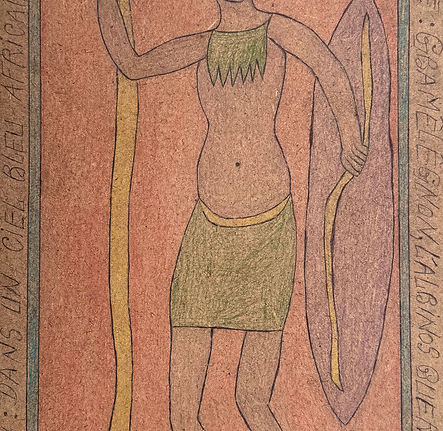
Bouabré’s drawing practice extended this attention to recording across a wide range of subjects. Using ballpoint pen and colored pencil, he worked on small sheets of card, including materials recovered from everyday packaging in Abidjan. His subjects encompassed cultural traditions, stories, beliefs, daily activities, and social concerns. Modest materials supported an extensive body of work built through repeated acts of observation and annotation. The scale of these drawings encourages close examination. From a distance, color, outline, and repeated arrangements are immediately apparent. At closer range, inscriptions and small details become legible. Image and text provide different kinds of information: a drawing depicts a form or situation, while a sentence may identify it, explain its significance, or record Bouabré’s interpretation. Understanding a work requires moving between these elements. Much of this production is associated with Connaissance du Monde, or Knowledge of the World. Organized into series and individual units, it includes observations of natural forms, stories retold through images, and records of cultural practices. Bouabré brought visible details and his interpretations of them into the same field. His drawings document both what attracted his attention and the meanings he assigned to it. The breadth of this undertaking gives it an encyclopedic character, yet its contents remain shaped by a particular observer. What Bouabré chose to draw matters as much as the quantity of his production. Familiar objects and passing encounters became subjects worthy of preservation. Across these works, the invention of a script and the accumulation of drawings address connected questions: how can something be recorded, and what should be retained?
From Venice Biennale to iO Arts Center New York
In 2026, 'Song E Yoon: Songs Across Time' brought Bouabré’s Alphabet Bété into dialogue with Song E Yoon’s Song E Code. Organized by The Foundation of ART NYC and curated by Seohyun Kang, the official Venice Biennale Collateral Event examined the relationship between visual signs, language, and communication through two systems developed in different cultural and historical circumstances. Bouabré’s syllabary uses established correspondences between signs and sounds to transcribe speech. Song E Yoon’s Song E Code uses two signs, ● and ○, whose spacing, sequence, repetition, and arrangement participate in the formation of meaning. Interpretation develops through relationships among the signs rather than a fixed definition assigned to each one. Their presentation in Venice allowed these different approaches to notation and interpretation to be considered together. The exhibition at iO Arts Center continues this research through a focused presentation of Bouabré’s work. A solo exhibition by Song E Yoon is also planned at the institution in 2027. The two exhibitions provide space to examine each artist’s practice in greater detail while maintaining the questions raised in Venice. Bouabré’s exhibition considers the relationship between a writing system and the knowledge it records; Song E Yoon’s forthcoming exhibition will explore the role of arrangement and reading in the production of meaning. Together, they extend the inquiry into how signs acquire meaning, how that meaning is transmitted, and how interpretation depends on rules and relationships.
About Frédéric Bruly Bouabré
Frédéric Bruly Bouabré was born in 1923 in Zéprégühé, near Daloa, Côte d’Ivoire. He attended French-language schools and served in the French Navy during the Second World War. He subsequently held administrative and research positions in Senegal and Côte d’Ivoire. Bouabré identified a visionary experience on March 11, 1948, as a turning point in his life and adopted the name Cheik Nadro, meaning “the one who does not forget.” His subsequent activities included the development of the Bété writing system and extensive writing on cultural, religious, and philosophical subjects. He died in Abidjan in 2014. Bouabré gained international recognition through Magiciens de la terre, held at the Centre Pompidou and the Grande Halle de la Villette in Paris in 1989. In 1994–95, Dia Center for the Arts in New York presented Worlds Envisioned: Alighiero e Boetti and Frédéric Bruly Bouabré. He participated in Documenta 11 in Kassel in 2002, and his work was presented at Tate Modern in London in 2010. In 2013, he was included in both The Encyclopedic Palace, the main exhibition of the 55th Venice Biennale, and Traces and Signs, the Côte d’Ivoire Pavilion.
In 2022, the Museum of Modern Art in New York presented Frédéric Bruly Bouabré: World Unbound, the first United States museum survey of his work and MoMA’s first exhibition devoted to an Ivorian artist. The exhibition brought together Alphabet Bété and hundreds of drawings, examining the connections among his linguistic research, cultural interests, and observations of daily life. In 2026, works from Alphabet Bété were included in 'Song E Yoon: Songs Across Time', an official Collateral Event of the 61st Venice Biennale. On December 19, 2026, Dia Beacon is scheduled to open Frédéric Bruly Bouabré, its second presentation of his work following the 1994–95 exhibition. Curated by Ella den Elzen, the exhibition will present works on paper associated with Connaissance du Monde and mark Dia’s first acquisition of Bouabré’s work. Its subjects include animals, tools, hunting traps, pyramids, and markings on kola nuts, reflecting his attention to the relationship between everyday observation and broader systems of knowledge.
Opening three days later, iO Arts Center’s exhibition will present more than 100 works, including the 20 Alphabet Bété drawings exhibited in Venice. It begins a sequence of exhibitions at the institution that will continue with Song E Yoon’s solo presentation in 2027.
Meet The Team
Frederic Bruly Bouabre
Founder & CEO

Frederic Bruly Bouabre
Tech Lead

Frederic Bruly Bouabre
Office Manager

Frederic Bruly Bouabre
Product Manager

Frederic Bruly Bouabre
HR Lead

Frederic Bruly Bouabre
Customer Support Lead