
SCIENTISTS AS ARTISTS
NORMAN GALINSKY | PHILIP DAVID ZELAZO
Sep September 25~ October 16, 2026
Sep


Don Francis
Founder & CEO

Ashley Jones
Tech Lead
Tess Brown
Office Manager

Lisa Rose
Product Manager

Kevin Nye
HR Lead

Alex Young
Customer Support Lead
ARTISTS’ BIOS
NORMAN GALINSKY’S art represents an intimate relationship between the energetic and quantum nature of reality and the spiritual essence embodied by art. He believes that art expression is energy itself—an aspect of what the Chinese call Qi, the universal life energy. The images depict a “stillness in motion,” drawing the viewer into a meditative dialog with the present moment. He has been influenced by his practice and teaching of Chinese martial arts, Tai Ji Quan and qigong exercises, as well as study of other energetic healing disciplines. Additionally, his earlier career and professional background in chemical engineering has been instrumental in combining his use of mathematics with “permutational” and intuitive approaches to making art. Finally, he has used his understanding and study of sacred geometry as a roadmap to explore how energy, science, and esthetics can be related.
Galinsky has studied with such notable figures as Philip Guston, Jack Tworkov, Stamos, Henry Pearson, George Tooker and Dorthea Rockburn. He had his first exhibit in New York City at the Jock Truman Gallery (formerly The Betty Parsons Gallery) and has been exhibiting in solo and group exhibitions ever since. His most recent New York City exhibit was at the Sterling | Boos Gallery, 980 Madison Avenue. His painting, Spiral Cluster is featured in the opening pages of the New York Times best-seller, Your Brain on Art by Susan Magsamen and Ivy Ross.
https://www.normangalinsky.com/
PHILIP DAVID ZELAZO, PHD, is the Nancy M. and John E. Lindahl Leadership Chair at the Institute of Child Development at the University of Minnesota, where he co-directs the Developmental Social Cognitive Neuroscience Lab with Institute for Child Development Director Stephanie Carlson. His pioneering research has helped shape current understanding of the development of conscious control over thought, action, and emotion, and his work has been cited more than 57,000 times. Zelazo has been the recipient of multiple awards and honors, including the Boyd McCandless Young Scientist Award in 1996 and the 2025 Award for Distinguished Contributions to Developmental Psychology from the American Psychological Association.
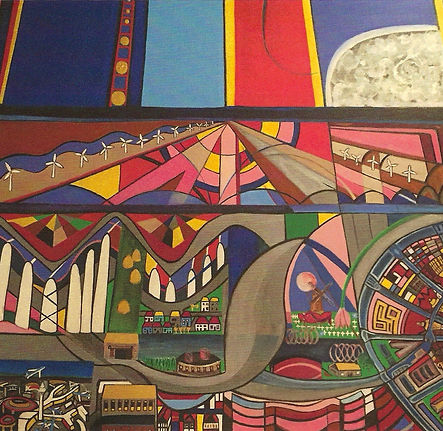
His book, Executive Function, Reflection, and the Developing Brain, will be published by MIT Press in early 2027. Zelazo considers his paintings to be complementary explorations of the nature of consciousness: they explore the dynamic subjective construction of reality and highlight the multiplicity of possible perspectives and interpretations that are afforded by even relatively simple organic and abstract systems. His paintings are designed to engage viewers, inviting them to pause and reflect as a variety of interpretive configurations emerge, recede, recombine, and reemerge reinterpreted. The painting Idea ex Plenum was featured on the cover of the September, 2025 issue of American Psychologist.


